Practical guide · Classroom observation
Teacher Observation Checklist
A free printable checklist, six classroom look-for areas, and practical guidance for principals and school leaders.
Free printable teacher observation checklist
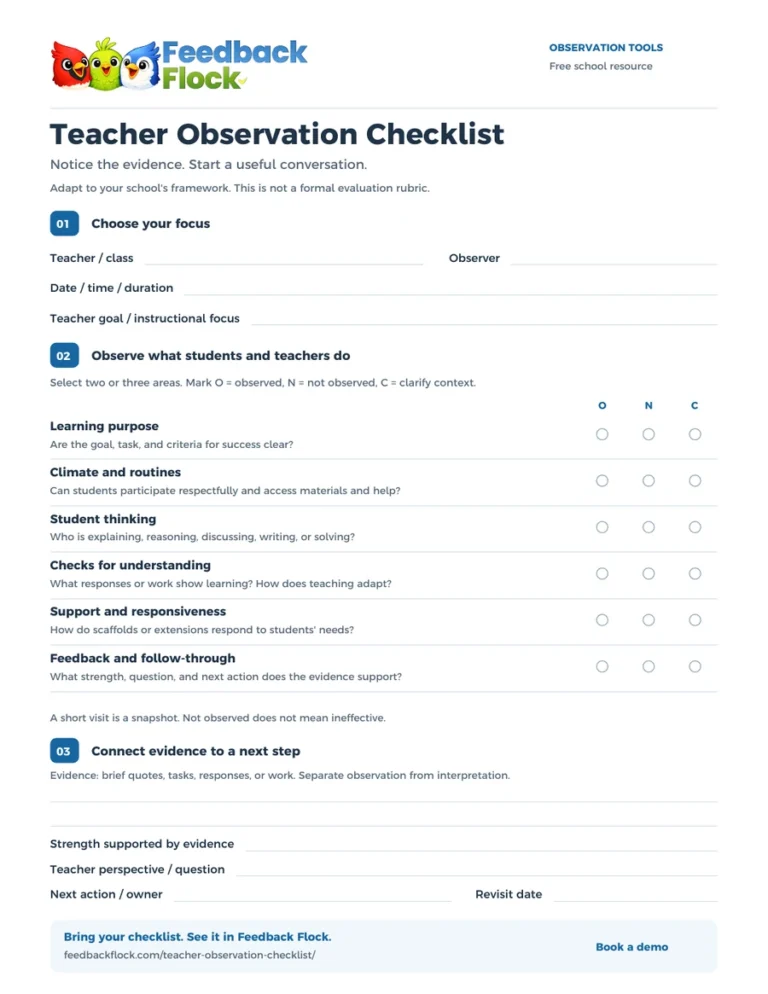
Open the full-size PDF to read or print.
Print this teacher observation checklist for your next classroom visit. It includes six look-for areas, space for evidence, and a strength, question, next action, and revisit date. Print it and write by hand. No email or signup required.
Download the free checklist (PDF)PDF, 1 page, US Letter, 182 KB. This is a blank planning tool, not a completed observation or formal evaluation rubric.

AI-generated illustration for Feedback Flock. Does not depict a real customer or school.
A teacher observation should lead to a useful conversation about instruction, not another form that sits in a folder. Whether you are a principal making a short walkthrough or an academic leader coordinating a formal cycle, a simple teacher observation checklist can help you focus on what matters: what students and teachers actually do, what that reveals about learning, and what to try next.
The checklist below is designed for K-12 schools, including independent and faith-based schools that use their own instructional framework. It is intentionally flexible. Use it as a starting point, not as a substitute for your school's approved evaluation rubric.
What makes an effective teacher observation checklist?
A useful checklist identifies observable practices, separates evidence from interpretation, and leaves room for follow-up. The Delaware observation framework supports evidence collection and coaching, with performance ratings assigned at the end of the year using evidence from multiple visits. The Institute of Education Sciences research summary highlights constructive, specific feedback and access to professional learning as supports for teacher growth.
That leads to three practical principles:
- Observe before judging. Write what you heard, saw, or counted instead of labeling a lesson “great” or “weak.”
- Keep the focus narrow. During a short visit, choose two or three look-fors rather than attempting to evaluate every part of instruction.
- Close the loop. A useful observation produces a strength, a question or next step, and a plan to revisit the practice.
Teacher observation checklist: classroom look-fors
Choose the items that match the lesson objective, prior coaching conversation, and visit duration. On the printable checklist, mark O for observed, N for not observed during this visit, or C for context to clarify. N is a limit on what you saw, not a negative rating. Leave unrelated items blank and record evidence for the areas you selected.
1. Learning purpose and clarity
- Is the learning goal evident through teacher explanation, student work, or classroom materials?
- Can students explain the task they are working on and what success would look like?
- Do lesson activities connect logically to the intended learning?
2. Classroom climate and routines
- How do the teacher and students speak and respond to one another?
- Are transitions clear enough to preserve learning time?
- Are students able to access materials, directions, and help?
- What evidence suggests students can participate safely and respectfully?
3. Student thinking and engagement
- Who is doing the intellectual work: explaining, solving, discussing, writing, or practicing?
- Do questions invite more than one-word answers when deeper thinking is appropriate?
- Are participation structures bringing different students into the lesson?
- What do student responses reveal about misconceptions or understanding?
4. Checks for understanding
- Does the teacher gather information from more than the most vocal students?
- Can you identify a checkpoint, exit task, response, or student work sample?
- Does instruction change when student responses signal confusion?
- Is there enough evidence to know what students learned, not just what the teacher presented?
5. Responsiveness and support
- Are examples, scaffolds, or extensions available when needed?
- How does the teacher respond when a student is stuck?
- Are students with different starting points able to engage in the learning task?
- What should the observer ask about context before interpreting what was seen?
6. Feedback and next steps
- What is one instructional strength supported by a concrete example?
- What is one high-leverage question or improvement opportunity?
- How will the teacher know whether a small change helped?
- When will the next observation or coaching conversation occur?
Use your school’s checklist in Feedback Flock
Bring a blank copy of your current observation form. Ask to see how your rubric, descriptive notes, reviewed feedback, and teacher history could stay connected. Confirm the workflow and plan that fit your school.
See my school’s checklist in a demoA fuller observation record you can copy
Use this outline when you need more space than a short walkthrough checklist. Copy it into your school's approved document or form.
- Context: Teacher, observer, date, class, visit duration, lesson purpose, and teacher goal.
- Focus: Two or three agreed criteria from your school's framework.
- Evidence: Time-stamped notes, brief quotations, tasks, or work samples. Avoid student identifiers in shared coaching notes.
- Interpretation: What the evidence may suggest, what remains uncertain, and questions for the teacher.
- Conversation: A supported strength and the teacher's perspective.
- Action: One next step, the person responsible, support needed, and a follow-up date.
Turn evidence into useful feedback
Start with a specific moment from the lesson. Record what was said, done, or produced before deciding what it means. A checklist mark without supporting notes leaves the teacher guessing about the basis for your feedback.
Separate attention from learning. Listening, watching, and completing a task may show participation. To understand learning, look at explanations, responses, or student work connected to the lesson goal. If you did not see a check for understanding during the visit, record that limitation and ask the teacher what evidence they collected.
Invite the teacher's interpretation. Ask what students were working toward, what the teacher learned from their responses, and where the lesson changed. A brief classroom visit cannot establish a teacher's overall effectiveness or explain every instructional choice.
Agree on an action you can revisit. Connect one next step to the evidence and the teacher's goal. Record who will do what, the support needed, and when you will discuss the result. Harvard CEPR's Observation Cycle Record Checklist emphasizes evidence-based strengths and growth areas, teacher and observer actions, and timelines.
If you use AI to draft feedback: Verify every claim against the observation notes, remove assumptions, and review tone and context before sharing. Suggested strategies are options for a future lesson, not evidence that those activities occurred.
Using your teacher observation checklist before, during, and after
- Before: Review the teacher's goal, choose two or three look-fors, and clarify whether the visit is for coaching or evaluation. Align your checklist with the school's framework and explain how notes will be used.
- During: Watch students as well as the teacher. Capture brief quotations, tasks, responses, or work that relates to the focus. Mark items you did not see as not observed and note questions for context.
- After: Invite the teacher's interpretation, identify a supported strength, and agree on one next action. Record the owner, support, and follow-up date. Review AI-assisted drafts for accuracy before sharing.
Walkthrough checklist vs. formal evaluation rubric
A classroom walkthrough checklist helps an observer gather focused evidence quickly. A formal evaluation rubric explains criteria and performance levels, often within a required timeline, documentation, and review procedure. They can work together, but they serve different purposes.
For independent schools, the flexibility to customize an observation framework can be a benefit. Align the checklist to the school's mission and instructional expectations while preserving a consistent evidence record across observers. For public-school settings, follow the applicable district and state evaluation rules.
Adapt the checklist to the lesson
Keep the six areas as a menu rather than requiring every item on every visit. Before entering the room, connect your focus to the lesson purpose and the teacher's current goal. Choose the evidence you need to notice, then leave room for what actually happens. A short walkthrough and a fuller observation record can share criteria while allowing different amounts of detail.
Match the evidence to the learning task
During discussion, attend to explanations, reasoning, and whose ideas enter the conversation. During independent practice, examine the task, a manageable sample of responses, and how students obtain help. During a demonstration, look for opportunities to reveal understanding before students work alone. These are suggested observation approaches, not completed classroom examples. Select the approach that fits the instruction you are there to understand.
Avoid treating one participation format as the definition of engagement. A quiet student may be thinking carefully, and a busy group may still be uncertain about the content. When the evidence is incomplete, record a question rather than a conclusion. Ask the teacher how the task supports the intended learning and what they use to decide whether students are ready to move on.
Preserve context when you customize
For younger learners, consider how directions, materials, and routines make participation possible. In specialist, laboratory, or practical lessons, adapt the look-fors to the discipline and task. For students receiving additional support, ask about the planned scaffolds without copying private student information into routine coaching notes. Keep the instructional expectation clear while allowing different ways for students to demonstrate it.
Test a revised teacher observation checklist with a small set of visits before adopting it across a team. Ask whether its prompts helped capture useful evidence or distracted observers from the lesson. Remove duplicate questions, clarify ambiguous wording, and keep a version date on the form. Discuss changes with teachers so a revised checklist does not quietly become a new set of expectations.
Help observers use the checklist consistently
A shared form does not establish shared interpretation. The MET project guide Seeing It Clearly addresses preparing observers and improving observer training. A practical starting routine for your team is to review the same permitted lesson segment, write notes independently, and compare the evidence before discussing judgments. Use material your school is authorized to review and follow its recording and access rules.
Begin with one criterion. Ask each observer to identify the classroom event behind their conclusion and explain how it connects to the agreed look-for. Notice where observers recorded different moments, inferred information that was not visible, or used the same label differently. Keep a short record of the clarified language and unresolved questions. If ratings are required, use the school's approved rubric and training process.
When reviewing patterns across classrooms, check which criteria were observed, the number and duration of visits, and the instructional contexts sampled. Do not treat an unchecked box as a performance score or rank teachers from unequal samples. Use emerging patterns to frame questions about support and professional learning, then return to the underlying records before drawing conclusions. Revisit calibration when the form changes or new observers join.
A teacher observation checklist in Feedback Flock
One school's informal observation form in Feedback Flock includes:
- Safety and supervision
- Classroom management
- The teacher's physical presence during instruction
- Classroom organization and student workspace
- Alignment with lesson plans
- Appropriate use of technology
- Integration of the school's faith-based mission
- Assessment of learning
- Student engagement
- Additional written comments
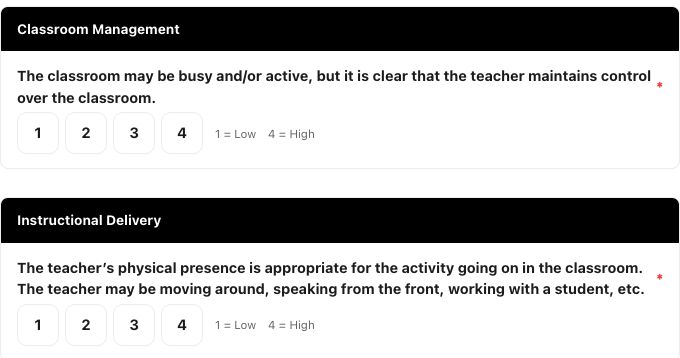
Real product screenshot of an unfilled teacher observation checklist. School identifiers and teacher data are excluded; no ratings are selected.
This list reflects an actual configured form demonstrated in Feedback Flock, with identifying details removed. It is one school's framework, rather than a universal template. A second informal form demonstrated in the product also includes a prompt asking the observer to connect feedback to the teacher's submitted goal. Choose the criteria and rating scale that match your school's approved process.
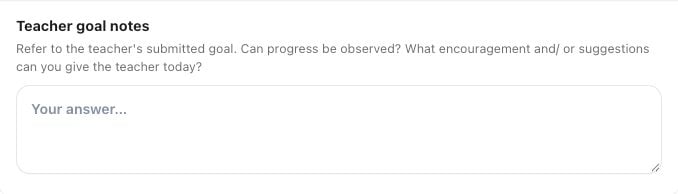
Real product screenshot of the empty teacher goal notes prompt. The observer is asked to consider progress toward the teacher's submitted goal and offer encouragement or suggestions. No teacher goal is displayed.
From recorded evidence to reviewed feedback
The observation: In the completed record demonstrated to us, the observer paired rubric ratings with written comments about vocabulary instruction, classroom organization, and student engagement. Names, dates, scores, and identifying lesson details are omitted here. This is a paraphrased account of a real workflow, not a customer quotation or an endorsement.
The useful distinction: The observer described students listening and watching the presentation, while acknowledging that understanding can be difficult to assess during a discussion or presentation-based lesson. That separates evidence of attention from evidence of learning. Recording both gives the teacher a clearer basis for deciding what to check next.
The AI-assisted draft: Selecting Feedback opened an editable email draft with a subject and message. It expanded the recorded strengths and suggested brief checks for understanding, such as exit tickets or individual responses. These were AI-proposed strategies for a future lesson, not activities documented in the observation.
The observer's review: The screen explicitly asks the observer to review and edit before sending. Check that each statement is supported by the record, remove assumptions, and decide whether the proposed next step fits the teacher's context. An AI draft is a starting point for professional judgment. Keep the feedback specific enough for the teacher to act on and accurate enough to stand behind.
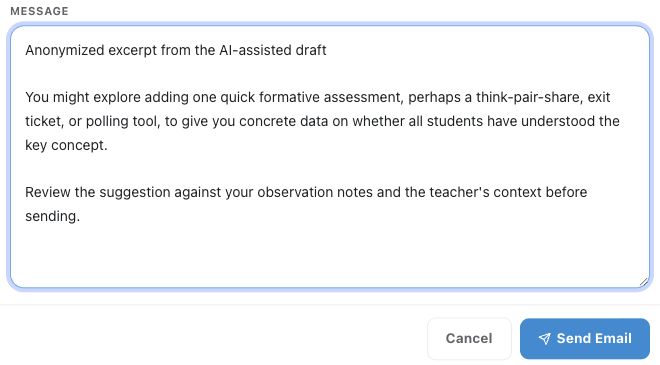
Real feedback editor with an anonymized, shortened excerpt. Text was edited for this demonstration, including a review reminder. No email was sent.
Following through: The demonstrated observation also displayed separate teacher visibility and viewed statuses. These help a leader distinguish a released observation from one a teacher has opened. A viewed status does not establish agreement, improvement, or completion of a coaching conversation.
How software can support the observation cycle
A paper form can work well for an individual visit. The challenge comes when a principal team needs to coordinate walkthroughs, preserve feedback history, and identify follow-up priorities without scattered spreadsheets and email threads.
Explore how Feedback Flock teacher observation software could support your school’s rubric, evidence collection, and feedback process. Bring your existing form to a demo and confirm the workflow and current plan options with the team.
Read more about the platform: Explore teacher observation software
Already have a form but want to customize it? Create a custom teacher observation form
Teacher observation checklist FAQs
What should a teacher observation checklist include?
A clear instructional focus, classroom evidence, student responses, one evidence-backed strength, one possible next step, and a plan to follow up. Add rubric fields when your school's process requires them.
How long should a teacher observation take?
The visit length depends on whether it is a brief walkthrough, a coaching observation, or a formal evaluation. The checklist should fit the purpose. Do not draw sweeping conclusions from a short snapshot.
Can AI write teacher observation feedback?
AI can assist with drafting from documented notes, but it cannot verify what happened in the classroom by itself. The school leader should review, correct, and approve the feedback before it is shared.
Does “not observed” mean the teacher performed poorly?
No. On this printable, N means the practice was not observed during this visit. It does not automatically mean ineffective practice. Choose the items relevant to the lesson and your agreed focus, leave unrelated items blank, and record questions where context is missing. Use your school’s approved rubric and evaluation procedures for formal judgments.
Can I adapt this checklist to my school’s framework?
Yes. Use the six areas as a starting menu, then select or revise look-fors to match your school’s approved framework and the purpose of the visit. Keep the evidence record separate from a formal rating. Test a change with a small set of visits, discuss it with teachers and observers, and keep a version date on the form.
A better observation starts with a better conversation
Download the printable teacher observation checklist for your next visit. Choose a narrow focus, capture observable evidence, and plan a useful conversation. For more help separating evidence from judgment, read how to write better classroom observation notes.
Sources and further reading
Institute of Education Sciences: Research on evaluation and professional growth
Delaware Department of Education: Delaware classroom observation framework
Harvard Center for Education Policy Research: Observation Cycle Record Checklist. A resource for reviewing completed observation records and planning evidence-based next steps.
Related reading: A smarter approach to teacher observations.
Bring your checklist. See the whole workflow.
Bring your current teacher observation checklist to a demo. See how your rubric, evidence notes, and reviewed feedback could fit a shared observation workflow.
Book my school’s demo