
A practical guide for school leaders
Classroom Observation Evidence7 ways to write notes a teacher can use
Classroom observation evidence records what a teacher and students said, did, wrote, or produced during a specific visit. Useful notes preserve the event and its context before adding an interpretation, rating, or recommendation.
You do not need a transcript of the whole lesson. You need a record the teacher can recognize, with enough detail to explain your question and enough honesty to show what remains unknown. This guide gives principals and instructional coaches examples, seven practices, and a note format to use with an existing notebook or observation form.
A useful sequence: record the context, describe the action and student response, then review the evidence against your framework. Keep the interpretation and next question separate from the original record.

What counts as useful classroom observation evidence?
A judgment such as “students were disengaged” gives the teacher little to examine. A descriptive note identifies the moment, the activity, and what the observer actually saw. The two examples below show how to make both a concern and a strength more useful.
From a concern to a record you can discuss
- Impression
- “Students were disengaged.”
- Descriptive evidence
- “At 10:14, six minutes into independent practice, 6 of the 20 students were writing when I scanned the room. I did not inspect their work or record what the other students were doing.”
- Question to explore
- “What were you hoping students would practice, and what did their work show?”
What the note does not establish: writing alone does not show understanding. One scan does not establish engagement throughout the lesson or explain why a student was not writing.
From broad praise to a specific strength
- Impression
- “Excellent differentiation.”
- Descriptive evidence
- “Students used three task versions addressing the same concept. The teacher explained how to select a starting point. Two students moved to another version after reviewing their initial responses.”
- Question to explore
- “How did you decide which starting points to offer, and what helped students choose?”
Why this helps: the teacher can identify the practice behind the praise. The note leaves room to ask about intended learning, student work, and what happened outside the visit.
Objective classroom evidence is useful when another reader can distinguish the event from your conclusion. It does not remove the need for professional judgment. It makes the basis for that judgment easier to examine.
During the visit and before you share
7 practices for clearer teacher observation notes
Record events before assigning labels
Capture a question, direction, response, task, or visible action. Instead of “checked understanding effectively,” describe the check and what students said or produced. If you record an exact quotation, use the words you heard. If you can only recall the meaning, label it as a paraphrase.
Keep a later rating or interpretation in a separate field or clearly labelled paragraph. A form can require judgment, but the label should not replace the classroom observation evidence behind it. Before finalizing a note, ask whether the teacher could locate the moment without having to guess what you meant.
Add the context that changes the meaning
Record the activity, the stated expectation, and the observation window. Talking during a silent assessment means something different from talking during assigned partner work. State when you entered and which part of the lesson you saw; a six-minute sample should not read like an account of the whole period.
Keep sources identifiable. A teacher explanation after the visit, a planning document, and work reviewed later can add context. Record each as additional information rather than rewriting the original note as though you witnessed it. This also makes it easier to resolve a factual correction without losing the original sequence.
Make counts honest and useful
Write what you counted, when, and from which group. “Eight of twenty students responded during this check” is different from “most students did not understand.” Do not turn a general impression into a percentage afterward. If you did not count, say what you noticed without inventing precision.
A participation count is not automatically student learning evidence. Pair a number with the behavior, explanation, or work it describes. Record the limits: perhaps you heard only volunteers, reviewed three responses, or could not see the back table. Those limits matter when deciding what the sample can support.
Capture student thinking alongside teacher actions
Look for explanations, questions, written responses, and revisions. A list of the teacher’s questions leaves the learning picture incomplete if it says nothing about the responses. Distinguish a correct answer from an explanation of why it is correct, and a completed task from evidence of the intended learning.
Choose a note format that fits the question. Time markers help with transitions; a short quotation may help with reasoning; a participation record may help show whose voices were sampled. Follow school policy for identifiers, records, photographs, storage, and access. Keep details relevant to the instructional purpose.
Connect the evidence to the framework after collection
Use your school’s criteria to review what the record supports. One exchange may inform more than one criterion, but it should not be forced into every empty field. Classroom observation evidence may support one expectation clearly while leaving another unobserved.
Agree in advance how to record insufficient evidence. “Not observed” during one visit is not automatically the same as ineffective practice. Formal evaluation rules remain your school’s or district’s responsibility. Delaware’s observation framework is one example of using defined teacher and student behaviors to guide evidence collection; it is not a universal rubric for every school.
Check for hidden assumptions
Review adjectives and statements about what someone knew, felt, intended, or believed. “The teacher did not care about the confusion” assigns a motive. “The teacher moved to the next problem after two students requested another example” records an event and leaves room for a question about the decision.
Ask what supports each conclusion. Retain a justified interpretation when the process calls for it, but label it and connect it to the record. Low-inference observation notes help preserve this distinction. They do not make an observer free from perspective or eliminate the need to consider context with the teacher.
Turn the record into one focused question
Choose a moment or pattern that matters to the agreed instructional focus. Explain the evidence behind your question, invite the teacher’s context, and identify a manageable next step together. Instructional feedback becomes more concrete when both people can return to the same classroom event.
Keep other useful notes without treating every detail as a separate improvement request. Record what you will revisit, when, and what would help you understand the next attempt. A viewed report does not establish agreement or improvement; the follow-up conversation and later evidence still matter.
A classroom observation evidence note format you can reuse
Use these prompts in the notebook or form your school already has. Keep the record short enough to use while listening. The format supports classroom walkthrough notes and longer observations; the scope of the record should match the visit.
- Focus and context
- What instructional question are you exploring? Which lesson segment, stated expectation, and observation window did you see?
- Time and teacher action
- Record the time marker, direction, question, response, or change in the task.
- Student response and sample
- Capture a quotation, work description, or honest count. Identify what you sampled and what remains unknown.
- Source
- Label direct observation, teacher explanation, or a document or artifact reviewed later.
- Interpretation and next question
- After reviewing the evidence, identify the relevant criterion, explain your reasoning, and write one question for the conversation.
- Next check
- Record the agreed action or further evidence to seek, who will follow up, and the planned revisit.
Before sharing, check:
- Could the teacher recognize the moment and its context?
- Are observations, later explanations, and interpretations distinguishable?
- Do any numbers claim more than the sample supports?
- Are unsupported criteria marked according to your school’s process?
- Is the next question specific enough to discuss?
For a printable companion, use our free teacher observation checklist. It includes space for evidence and follow-up. The printable is available without an email signup.
Help observers read the same evidence consistently
Give observers the same permitted sample and ask them to write notes independently before discussing a rating. Compare what each person recorded, where an interpretation entered, and which criterion the evidence supports. Discuss differences in the record before trying to settle the score.
The ETS/MET brief Foundations of Observation addresses shared instruments, observer training, calibration, and continued monitoring for scoring quality. It does not cover how to give effective feedback. Use it for that narrower observation-system question, alongside your school’s feedback and evaluation procedures.
Revisit calibration when observers or forms change. Do not compare teachers from uneven samples as though the observation opportunities were identical. Consider the lesson segments, dates, forms, and observers represented before treating a trend as a conclusion about practice.
Keep classroom observation evidence separate from the draft
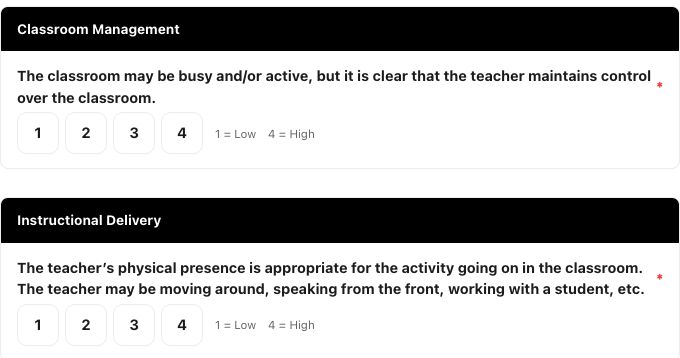
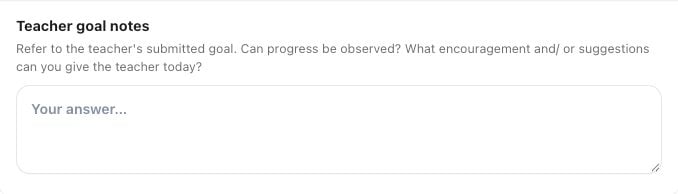
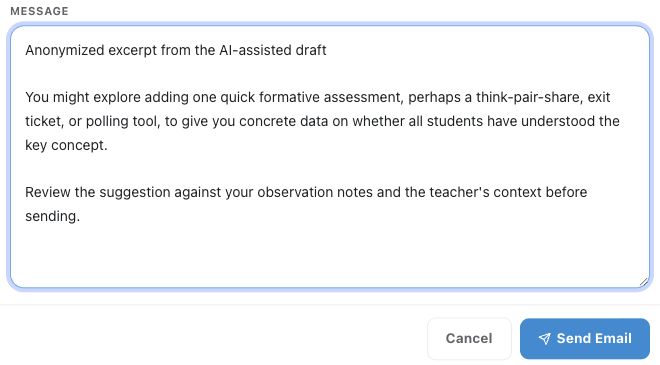
A digital workflow can help preserve notes and make earlier feedback easier to find. It still needs clear fields and a reviewer who checks what the record supports. These sanitized product views show three parts of that distinction in Feedback Flock; the same questions are useful when reviewing any observation form.
Record the context: an empty prompt is a place to document what you observed. If a goal was not visible during the visit, say so rather than supplying a conclusion. Keep the teacher’s later explanation identifiable.
Review the draft: if AI assists with feedback, compare every statement with the original notes. Remove invented details, distinguish a proposed strategy from an observed event, and check the tone and recipients. A fluent draft is not additional evidence.
Explore Feedback Flock teacher observation software for custom forms, teacher history, and reviewed feedback. AI-assisted feedback is included on School Plus and District. If you are comparing platforms, use our teacher observation tools buying guide and test each option with the same permitted sample notes.
Classroom observation evidence FAQs
What is classroom observation evidence?
It is the record of what teachers and students said, did, wrote, or produced during a specified visit. Include the context and the source. Keep a later interpretation, rating, or recommendation distinguishable from the observed event.
What are low-inference observation notes?
They describe observable actions and responses with as little unsupported interpretation as possible. “Two students asked for another example” is a record you can examine. “The class was confused” needs more evidence and context. Use quotations only when you recorded the words; otherwise identify a paraphrase.
How much evidence is enough for a short walkthrough?
Enough to support the narrow question you are discussing, with the sample’s limits stated. There is no universal number of notes that makes a brief visit representative of all teaching. A focused observation may raise a useful question while leaving formal criteria unobserved. Follow your school’s requirements for formal evaluation.
What if I did not observe a rubric indicator?
Use your school’s agreed designation for insufficient evidence. Do not turn an empty field into a negative rating automatically. Record the visit’s scope, ask for relevant context where appropriate, and identify whether another visit or evidence source is needed.
Can AI write classroom observation evidence or feedback?
AI cannot establish what happened in a classroom from information you did not record. If it helps organize notes or draft feedback, check the result against the original record. Remove unsupported claims and keep the observer responsible for interpretation and sharing. A suggested next strategy belongs in the plan, not in the account of the visit.