Teacher Observations
A Smarter Way to Improve Instruction
Teacher observations are one of the most powerful tools for improving instruction, but in most schools, they are inconsistent, time-consuming, and difficult to manage at scale.
Administrators are balancing walkthroughs, formal evaluations, and ongoing coaching conversations. Feedback is often delayed, notes are scattered across different systems, and there is little visibility into long-term teacher growth. Without a structured approach, even well-intentioned observation efforts can fall short of driving meaningful improvement.
This guide breaks down how to run effective teacher observations and how modern schools are simplifying the entire process with purpose-built tools like Feedback Flock.
What Are Teacher Observations?
Teacher observations are structured classroom visits designed to evaluate instructional practices, provide feedback, and support professional growth. These observations can range from informal walkthroughs to formal evaluations, but their core purpose remains the same: to improve teaching and learning.
When implemented effectively, teacher observations provide valuable insights into what is happening in the classroom. They allow instructional leaders to identify strengths, uncover areas for improvement, and align teaching practices with school-wide goals and standards.
More importantly, observations create an opportunity for meaningful dialogue between teachers and administrators. Rather than being seen as a one-time evaluation, they should function as part of an ongoing cycle of feedback, reflection, and growth that continuously strengthens instructional quality.
The Real Challenges with Teacher Observations
Most schools do not struggle with understanding the importance of teacher observations. The real challenge lies in executing them in a way that is consistent, efficient, and impactful.
Common challenges include:
- Inconsistent feedback across different observers, leading to confusion and lack of trust
- Time-consuming note-taking that distracts from actually observing instruction
- Delayed feedback that reduces its effectiveness and relevance
- Lack of visibility into trends across classrooms, teams, or departments
- Difficulty tracking teacher growth over time in a meaningful way
These challenges often stem from relying on disconnected systems or manual processes. When observations are not streamlined, they tend to become compliance-driven rather than growth-focused.
As a result, teachers may view observations as evaluative checkboxes instead of opportunities for professional development. Addressing these challenges requires not just better intentions, but better systems.
What Effective Teacher Observations Should Include
To truly impact instruction, observations need to be structured in a way that drives meaningful improvement, not just documentation. Without clear expectations and consistency, observations can quickly become subjective and lose their value as a growth tool. Many schools rely on established instructional frameworks, such as the Danielson Framework, to guide what effective teaching looks like and ensure observations are aligned to meaningful standards.
Focused Observation Goals
Effective teacher observations begin with clear alignment to instructional goals and established standards. Observers should know exactly what they are looking for before entering the classroom, whether that is student engagement, questioning strategies, or lesson clarity. A focused observation prevents feedback from becoming scattered and ensures that teachers receive insights that are directly tied to improving student outcomes.
Evidence-Based Feedback
Strong observations rely on objective, observable evidence rather than general impressions or opinions. Instead of vague comments like “students seemed engaged,” observers should capture specific behaviors, quotes, and interactions that occurred during the lesson. This level of specificity not only makes feedback more credible, but also helps teachers clearly understand what they are doing well and where adjustments are needed.
Timely Teacher Results
Feedback is most effective when it is delivered as close to the observation as possible. When days or weeks pass before feedback is shared, the impact is significantly reduced because the lesson is no longer fresh in the teacher’s mind. Timely feedback allows teachers to reflect immediately, make quick adjustments, and apply improvements in their very next lesson.
Actionable Insights
Observations should always lead to clear next steps that teachers can implement right away. Instead of simply pointing out areas for improvement, feedback should include specific strategies or suggestions for growth. This transforms observations from evaluative moments into coaching opportunities that actively support teacher development.
Consistent Scheduling
Consistency across observers is critical to building trust and ensuring fairness. When different administrators provide vastly different feedback on similar lessons, it creates confusion and reduces the credibility of the process. Using shared rubrics, clear criteria, and standardized systems helps ensure that all teachers are evaluated and supported in a consistent and reliable way.
What to Look for During Classroom Observations
High-quality observations focus on the instructional practices that have the greatest impact on student learning. While every classroom is different, there are core elements that consistently indicate strong teaching and effective learning environments. Observers should train themselves to look beyond surface-level behaviors and focus on what is actually driving student understanding and engagement.
- Instructional clarity and delivery
Teachers should present content in a way that is structured, easy to follow, and aligned with lesson objectives. Clear explanations, modeling, and logical progression all contribute to stronger comprehension. - Student engagement and participation
Observers should look for active involvement from students, not just passive listening. This includes participation in discussions, collaboration, and visible thinking throughout the lesson. - Classroom management and culture
A well-managed classroom creates a safe, respectful, and productive learning environment. This includes clear expectations, smooth transitions, and positive teacher-student relationships. - Differentiation and responsiveness
Effective teachers adjust instruction based on student needs, whether through scaffolding, questioning, or targeted support. Observers should look for evidence that instruction is not one-size-fits-all. - Questioning and critical thinking
Strong instruction challenges students to think deeply rather than simply recall information. Observers should pay attention to the types of questions being asked and how students are encouraged to respond.
The goal is not just to identify whether these elements are present, but to understand how effectively they are being executed and how they impact student learning.
Why Traditional Observation Methods Fall Short
Many schools still rely on outdated systems to manage teacher observations, which creates inefficiencies and limits the overall impact of the process. While these methods may have worked in the past, they struggle to keep up with the demands of modern instructional leadership.
Common approaches include paper forms, spreadsheets, and disconnected digital documents. While these tools can capture information, they often make it difficult to organize, analyze, and act on that data in a meaningful way.
These limitations lead to several challenges:
- Observations take longer to complete, reducing the number of classrooms leaders can visit
- Feedback is often delayed or inconsistent, lowering its effectiveness
- Data is fragmented, making it difficult to identify trends across teachers or departments
- There is little accountability or follow-through on coaching conversations
As a result, observations become more about checking a box than driving real instructional improvement. For schools looking to scale their impact, these traditional methods simply do not provide the structure or efficiency needed.
How to Streamline Teacher Observations at Scale
As schools grow and expectations increase, observation systems need to evolve to keep pace. A scalable approach allows administrators to conduct more observations, provide better feedback, and gain clearer insights without adding unnecessary workload.
A streamlined observation process should prioritize efficiency without sacrificing quality. This means reducing friction at every stage, from note-taking to feedback delivery to long-term tracking.
An effective system should enable schools to:
- Capture detailed notes quickly during live classroom walkthroughs without disrupting the observation
- Apply consistent rubrics and frameworks across all observers to ensure alignment
- Deliver structured, easy-to-understand feedback immediately after the observation
- Track teacher progress over time to support ongoing coaching and development
- Identify patterns and trends across classrooms, grade levels, and departments
When these elements are in place, observations shift from being isolated events to part of a continuous improvement cycle that supports both teachers and instructional leaders.
See how Feedback Flock simplifies walkthroughs and feedback for your team.
Using Classroom Observation Software to Improve Outcomes
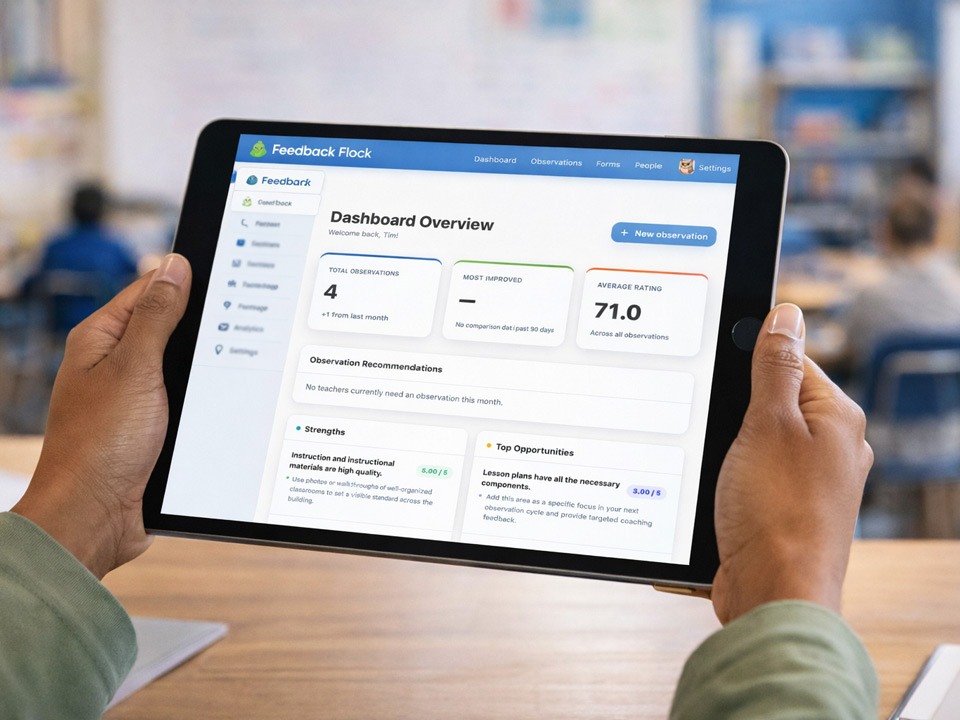
Technology plays a critical role in modernizing teacher observations and making them more effective at scale. Purpose-built classroom observation software eliminates many of the inefficiencies associated with traditional methods and provides a centralized system for managing the entire process.
Instead of juggling multiple tools, administrators can capture observations, deliver feedback, and analyze performance all in one place. This not only saves time, but also ensures that important data is never lost or overlooked.
With the right platform, schools can:
- Conduct faster and more efficient classroom walkthroughs
- Standardize observation criteria across all evaluators
- Provide immediate, structured feedback to teachers
- Track growth over time with clear, accessible data
- Use insights to inform coaching, professional development, and school-wide strategy
Platforms like Feedback Flock are designed specifically to support this approach, helping schools move beyond fragmented systems and toward a more streamlined, data-driven observation process.
From Compliance to Coaching
The biggest shift in teacher observations is not just about adopting new tools, but about changing the mindset behind the process. Observations should not feel like isolated evaluations, but rather part of an ongoing coaching cycle that supports continuous improvement.
When observations are easier to complete, more consistent across observers, and more actionable for teachers, they begin to drive real change. Teachers become more open to feedback, administrators gain clearer insights, and instructional conversations become more productive.
This shift leads to stronger teaching practices, higher levels of teacher engagement, and ultimately better outcomes for students. By focusing on growth rather than compliance, schools can unlock the full potential of their observation process.
Ready to Simplify Teacher Observations?
If your current observation process feels manual, inconsistent, or difficult to scale, it is likely limiting your ability to support teachers effectively.
Modern schools are moving toward systems that make observations faster, more structured, and more impactful without adding additional workload for administrators.
See how Feedback Flock helps schools streamline teacher observations, deliver better feedback, and gain real visibility into instructional growth.
Frequently Asked Questions About Teacher Observations
What is the purpose of teacher observations?
The primary purpose of teacher observations is to improve instructional quality by providing structured feedback and identifying opportunities for professional growth. Observations help align teaching practices with school goals while supporting better student outcomes.
How often should teacher observations be conducted?
The frequency of teacher observations varies by school, but many instructional leaders aim for regular informal walkthroughs combined with periodic formal evaluations. More frequent, shorter observations often lead to more meaningful feedback and continuous improvement.
What should administrators look for during a teacher observation?
Administrators should focus on key indicators such as instructional clarity, student engagement, classroom management, and the use of effective questioning strategies. Observations should prioritize evidence that directly impacts student learning.
How do you give effective feedback after a teacher observation?
Effective feedback should be specific, timely, and actionable. It should include clear examples from the observation and provide practical next steps that teachers can implement immediately to improve their instruction.
What are the biggest challenges with teacher observations?
Common challenges include inconsistent feedback, time constraints, delayed follow-up, and difficulty tracking teacher progress over time. Many of these issues stem from using manual or disconnected systems.
How can schools make teacher observations more efficient?
Schools can improve efficiency by using structured frameworks, standardizing observation criteria, and leveraging classroom observation software to capture notes, deliver feedback, and track progress in one place.
What is the best software for teacher observations?
The best teacher observation software is one that makes it easy to capture evidence in real time, deliver consistent feedback, and track teacher growth over time. Platforms like Feedback Flock are designed specifically for schools, helping administrators streamline walkthroughs, standardize evaluations, and reduce the manual workload that often slows down the process. By centralizing observations, feedback, and performance data in one place, schools can move beyond compliance and create a more effective, growth-driven observation system.